
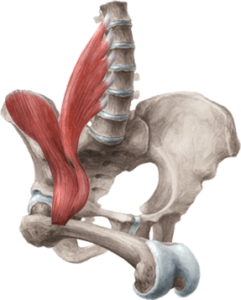
The Psoas: An Important Muscle for Body and Senses
The psoas is also called the muscle of the soul. This is because this deep muscle in our body is closely connected to our emotions, our posture, and our natural stress and survival mechanisms.
I was fortunate enough to take several courses with Liz Koch. During the first course, her explanation touched me deeply. I noticed that my body reacted in a way I had not expected. Feelings and memories that had been stored for a long time surfaced. It became clear to me that the body sometimes remembers more than we think.
Through Liz Koch’s knowledge, experience, and openness, I gained more insight into the role of the psoas in the body. For me, it became the beginning of a process of greater body awareness and self-insight.
As a result, my perspective on movement changed. It shifted from merely engaging in physical activity to conscious movement. After that, it became a quest to discover where movement actually begins in the body. Ultimately, for me, it is about being in motion in a natural and relaxed way. This journey has given me valuable insights and practical tools that I can also share with others. After all, our body has a strong, natural ability to heal itself and bring itself back into balance. It often begins with relearning to feel what is happening within the body.
The psoas can be a great gateway to making more contact with yourself.
Stress and the Psoas
In our current society, stress often leads to chronic tension, for example, due to work pressure or relationship problems. This can leave us feeling unsafe or anxious deep inside. The psoas, at the center of our body, responds strongly to this “fight-or-flight” response.
Normally, the psoas is a massive muscle of about 40 centimeters. Chronic stress can shorten this muscle by up to 10 centimeters. Furthermore, prolonged, passive sitting contributes to a shortened psoas. A shortened psoas causes dysfunction throughout the body: your hips become locked, and the psoas locks up.
Unlocking the Psoas
It is important to unlock the psoas to prevent or reduce physical complaints. A locked psoas can lead to:
- Lower back pain
- SI joint discomfort
- Sciatica Scoliosis
- Menstrual problems
- infertility Digestive problems
The psoas is often overlooked in these complaints. When doctors cannot find a clear cause, it is often called idiopathic: symptoms are present, but the cause remains unknown.
On my path of discovering and unlocking the psoas, I would like to join you on that path
Warm regards Anita
love opens your world, the result is you can admit joy, energy, and happiness, fear closes you off…… Loving energy, fear to close the energy
Bruce Lipton
PSOASRELEASE IS ONLY TAUGHT DURING WORKSHOPS AND WITH PSOAS-PULS
This post is also available in: